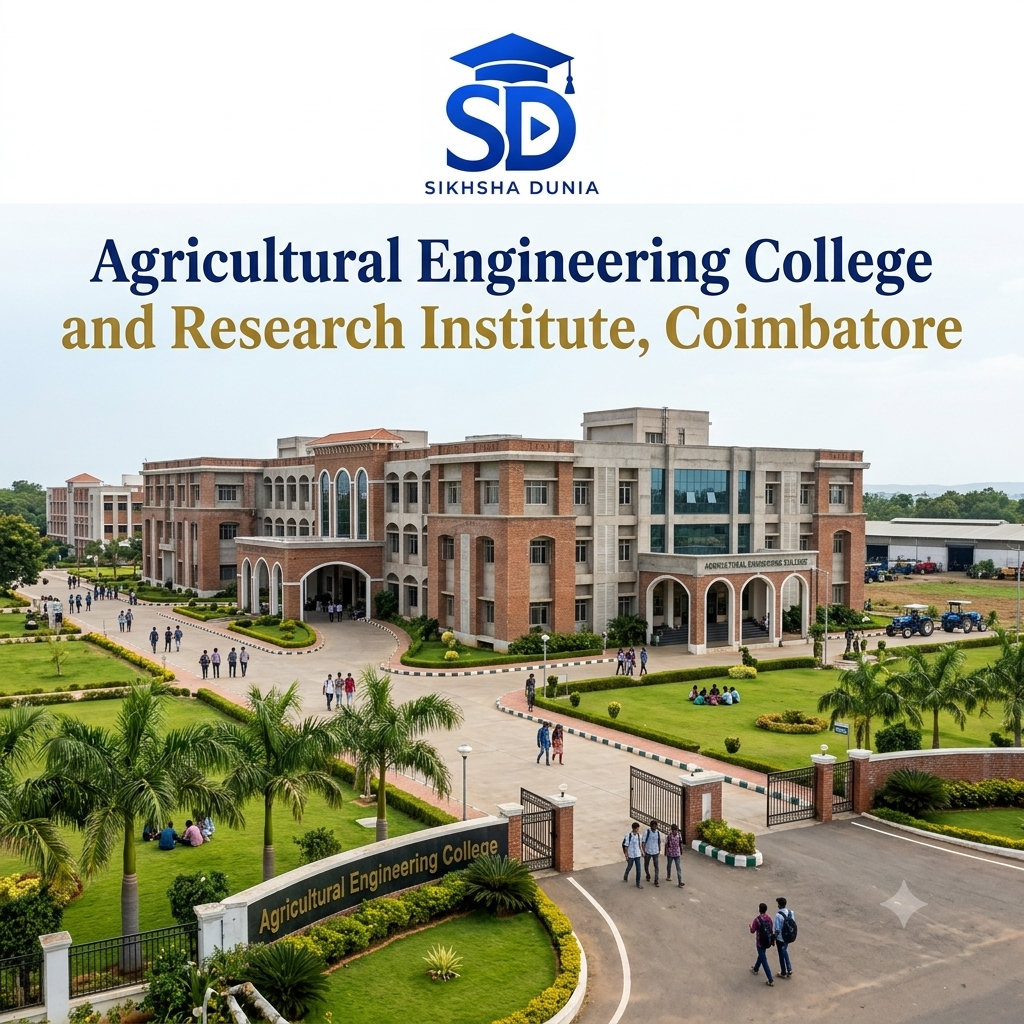
Agricultural Engineering College and Research Institute, Coimbatore
Established
1972
Location Type
Urban
College Type
Constituent / University College
Management
University
Affiliation
Ye college Tamilnadu Agricultural University, Coimbatore se affiliated hai (State Public University).
Is College Ke Baare Mein
Agricultural Engineering College and Research Institute, Coimbatore – Courses, Facilities and Admission
About us
Agricultural Engineering College and Research Institute, Coimbatore is a reputed agricultural engineering institution functioning under Tamil Nadu Agricultural University (TNAU), Tamil Nadu. The college focuses on providing quality technical education, advanced research opportunities and practical knowledge in the field of agricultural engineering. It aims to prepare students to understand modern agricultural challenges and develop innovative solutions that can improve farming practices and rural development.
The institute offers undergraduate, postgraduate and doctoral programmes in various specialised areas, including Agricultural Engineering, Food Technology, Renewable Energy and Environmental Engineering. With its emphasis on practical learning, scientific research and technological development, the college encourages students to build strong academic foundations and professional skills. Its educational approach combines classroom learning, research activities and hands-on experience to prepare graduates for opportunities in agriculture and related industries.
History
Agricultural Engineering College and Research Institute, Coimbatore has an important place in the development of agricultural engineering education in South India. It is recognised as the first college in South India to introduce a degree programme in Agricultural Engineering. The institution welcomed its first batch of students in July 1972 and has continued to contribute to technical education and agricultural research since then.
Over the years, the institute has expanded its academic programmes to meet the changing requirements of agriculture and technology. The Food Process Engineering programme was introduced in 1998, followed by Energy and Environmental Engineering in 2004. The Agricultural Engineering degree programme was reintroduced during the 2019–20 academic year, while Agricultural Information Technology was revived in 2023–24.
The college has also made significant contributions to agricultural research by developing modern machinery, equipment and technologies that support farmers and small-scale entrepreneurs. Its continuous efforts in education, innovation and research have strengthened its role in agricultural development.
Courses
Agricultural Engineering College and Research Institute, Coimbatore offers a variety of undergraduate, postgraduate and doctoral programmes for students interested in agricultural technology, engineering and research. These programmes are designed to provide subject knowledge along with technical and practical skills.
At the undergraduate level, students can pursue B.Tech. in Agricultural Engineering, B.Tech. in Food Technology, B.Tech. in Energy and Environmental Engineering and B.Tech. in Agricultural Information Technology. These four-year programmes help students understand agricultural machinery, food processing, renewable energy systems, environmental management and the application of information technology in agriculture.
For students interested in advanced studies, the college offers M.Tech. programmes in Processing and Food Engineering, Renewable Energy Engineering, Farm Machinery and Power Engineering, and Soil and Water Conservation Engineering.
The institute also provides doctoral research opportunities through Ph.D. programmes in Food Process Engineering, Renewable Energy Engineering, Farm Machinery and Power Engineering, and Soil and Water Conservation Engineering. These programmes are suitable for students who wish to develop specialised research knowledge and contribute to innovation in the agricultural sector.
Facilities
Agricultural Engineering College and Research Institute, Coimbatore provides various academic and campus facilities to support students throughout their educational journey. The institution focuses on creating an environment that encourages learning, research, practical training and extracurricular participation.
The library provides access to educational books, journals, research publications and digital learning resources. Students can use these resources to improve their subject knowledge and support their academic projects. The computer centre is equipped with computer systems and internet connectivity, helping students access online study materials and carry out research-related work.
The college also provides laboratory and departmental facilities that support practical learning in different areas of agricultural engineering. Students get opportunities to understand modern machinery, food processing techniques, renewable energy systems and soil and water conservation technologies.
Hostel accommodation is available for students, providing residential facilities for those coming from different parts of the country. Sports facilities encourage physical fitness and participation in recreational activities. Other student support facilities include a health centre, National Cadet Corps (NCC), National Service Scheme (NSS) and student clubs that promote social responsibility, leadership and overall personality development.
Placement and Career Opportunities
Agricultural Engineering College and Research Institute, Coimbatore provides placement support through its placement cell, which works to connect students with employment opportunities in different industries and organisations. Campus interviews and job fairs are organised to help graduating students explore suitable career options.
According to the institute's placement information, around 60 companies and organisations participate in campus recruitment activities annually, while approximately 450–500 graduates secure placements every year. Job fairs are also conducted, generally during March and April, providing additional opportunities for students to interact with recruiters. The selection process may include written examinations, group discussions and personal interviews.
Students can explore career opportunities in agricultural machinery manufacturing, food processing, renewable energy, irrigation systems, environmental management, banking, research organisations and agricultural technology companies. Graduates may also work in technical services, product development, quality control, business management and other related professional fields.
Some organisations that have participated in recruitment activities include Mahindra and Mahindra, ITC, Rasi Seeds, Texmo Industries, Mahyco, Cadbury, Axis Bank, HDFC and other companies operating in agriculture and allied sectors.
Students interested in higher education and research can also pursue postgraduate and doctoral studies to develop specialised expertise and build careers in teaching, scientific research and technological innovation.
Admission Process
Students interested in taking admission to Agricultural Engineering College and Research Institute, Coimbatore must fulfil the eligibility requirements prescribed by Tamil Nadu Agricultural University for their selected programme. The admission process generally depends on the academic qualifications, entrance requirements and university admission guidelines applicable to the respective course.
For undergraduate programmes, candidates must have completed their higher secondary education from a recognised board with the required subjects and eligibility conditions. Students applying for postgraduate programmes should possess a relevant bachelor's degree from a recognised institution. Applicants interested in Ph.D. programmes must meet the prescribed postgraduate academic and research eligibility requirements.
The admission process generally involves checking the course requirements, completing the application form, submitting the necessary academic documents and participating in the applicable selection or counselling procedure. Students should carefully review the latest admission notification issued by Tamil Nadu Agricultural University to understand application dates, eligibility criteria, selection procedures and fee details.
Why Choose
Agricultural Engineering College and Research Institute, Coimbatore is a suitable choice for students who want to build a career in agricultural engineering, food technology and related technical fields. Its long history of agricultural engineering education and association with Tamil Nadu Agricultural University provide students with an academic environment focused on learning, research and innovation.
The college offers multiple undergraduate, postgraduate and doctoral programmes, allowing students to select courses according to their academic interests and career goals. Its specialised departments provide opportunities to explore important areas such as farm machinery, renewable energy, food processing and soil and water conservation.
Another important advantage is the institution's focus on research and technological development. The college has developed several agricultural machines and technologies that support farming communities and improve agricultural productivity. Students can benefit from an environment where scientific knowledge and practical applications are closely connected.
The availability of library resources, computer facilities, laboratories, hostel accommodation, sports and student support services further contributes to a well-rounded educational experience. The placement cell also helps students explore employment opportunities across different industries.
Conclusion
Agricultural Engineering College and Research Institute, Coimbatore is an established institution dedicated to agricultural engineering education, scientific research and technological advancement. Since its establishment in 1972, the college has played an important role in developing skilled professionals and supporting innovation in the agricultural sector.
With its diverse academic programmes, specialised departments, research activities, modern learning resources and placement support, the institute provides opportunities for students interested in building careers in agriculture and allied industries. Its continued focus on practical education, sustainable technology and agricultural development makes it a noteworthy option for higher studies in Tamil Nadu. Students planning to apply should review the latest admission guidelines and course requirements before making their final decision.