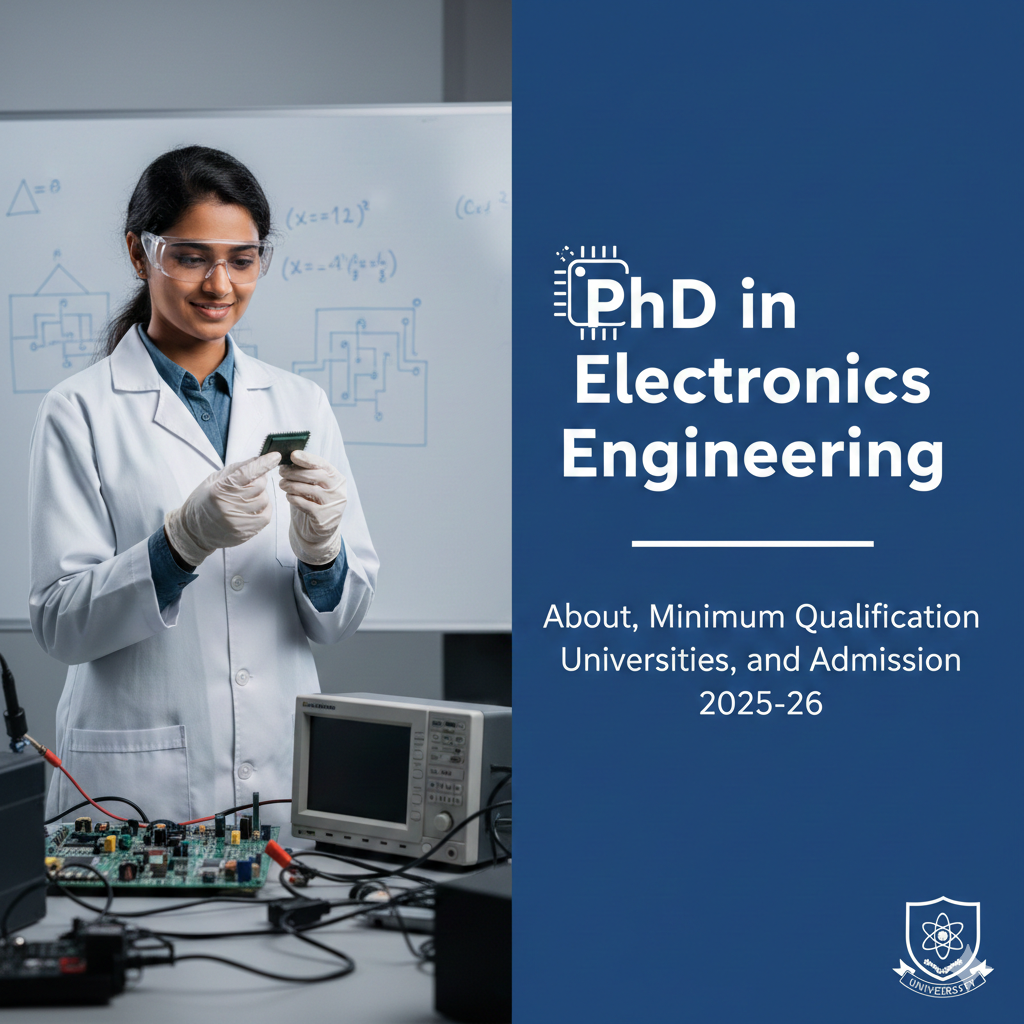
PhD in Electronics Engineering - About, Minimum Qualification, Universities, and Admission 2025-26
About This Course
The PhD program offered by the Department of Electrical and Electronics Engineering is designed to shape skilled researchers, innovators, and academic leaders who can drive meaningful transformation across the technology landscape. With a strong focus on advanced development, entrepreneurship, and real-world problem-solving, the program empowers scholars to contribute breakthrough ideas to the industry.
The Department has built a robust research culture in key emerging domains such as Wireless Communication, Signal Processing, AI & Machine Learning, Computer Vision, VLSI Design, and Embedded Systems. In the past three years alone, faculty and research scholars have published more than 400 papers in top-tier journals and conferences, along with filing over 30 patents—reflecting the department’s commitment to impactful research.
Along with the regular PhD track, the department also offers a collaborative PhD program with the Automotive Research Association of India (ARAI). These programs benefit from strong partnerships with reputed organizations like ISRO, IITM, ARAI, and Semiconductors Lab Chandigarh, ensuring access to cutting-edge resources, industry exposure, and global research opportunities.
PhD candidates work closely with expert supervisors, spending their time in labs, research discussions, and thesis development. Training in research methodology, presentation skills, and interdisciplinary collaboration further enhances their academic journey. Research opportunities span areas such as nanoelectronics, photonics, semiconductor electronics, radar systems, optical devices, and electromagnetic fields.
Typically lasting 4–5 years, the PhD in Electronics Engineering requires a Master’s degree with at least 55% marks. Admission may be merit-based or through entrance exams, with program fees ranging from INR 15,000 to 3 lakhs. Graduates can explore high-impact roles in semiconductor design, circuit simulation, product development, material analysis, robotics, automation, academia, and more. This doctoral pathway equips students to shape the future of modern electronic systems and emerging technologies.
Eligibility
Students aiming to pursue a Ph.D. must meet specific academic qualifications set by regulatory bodies and universities. Candidates are eligible if they have completed either a 1-year (2-semester) master’s program following a 4-year bachelor’s degree, or a traditional 2-year master’s degree after a 3-year bachelor’s program. These qualifications must include at least 55% aggregate marks or an equivalent grade. Degrees earned from accredited foreign institutions are also accepted, provided they meet recognized quality standards.
A 5% relaxation in marks is available for candidates from SC, ST, OBC (non-creamy layer), EWS, and differently-abled categories. However, applicants entering directly after a 4-year bachelor’s degree must have a minimum of 75% marks, with the same relaxation rule applicable to reserved categories as per commission guidelines.
Candidates who have completed an M.Phil program with a minimum of 55% marks (or its equivalent grade) are also eligible, with the same 5% relaxation offered for reserved and special categories. It is important to note that reservation benefits apply only to Maharashtra domicile candidates who submit valid documents before the interview. Applicants from outside Maharashtra are considered under the open category.
Many universities require candidates to hold an M.Phil or an equivalent postgraduate qualification in a relevant field from a recognized institution. Additionally, several institutes conduct their own admission processes, which may include personal interviews or subject-specific assessments. Some universities admit students through national or institutional entrance exams such as UGC NET or other Common Entrance Tests (CETs). To secure admission, candidates must achieve the minimum qualifying marks set by the respective institution.
This structured eligibility framework ensures that only motivated and academically prepared candidates advance to the rigorous Ph.D. journey, maintaining high academic and research standards across institutions.
Ph.D. Admission Process – Key Steps and Requirements
Candidates who meet the eligibility criteria are invited to appear for the MIT-WPU Ph.D. entrance test. However, applicants who have qualified national-level exams such as UGC-NET, UGC-CSIR NET, GATE (with a valid score), CEED, GPAT (valid score), or similar recognized tests are exempted from the entrance test.
The entrance test is qualifying in nature, with a minimum requirement of 50% marks. A relaxation of up to 5% (i.e., 45% qualifying marks) is granted to candidates belonging to SC, ST, OBC (Non-Creamy Layer), EWS, differently-abled, and other eligible categories. The exam consists of two sections—50% research methodology and 50% subject-specific questions.
Candidates who clear the test must attend a university-conducted interview or viva-voce. Final selection is based on 70% weightage from the entrance test and 30% from the interview performance. For students qualifying through GATE, NET, JRF, SET, GPAT, or CEED, admission is based solely on the interview.
Selected candidates receive official communication via email and are granted provisional admission. This admission remains provisional until verification of academic records, eligibility, and reservation documents is completed.
The university reserves the right to cancel admission in cases of misconduct, academic failure, fabricated documents, plagiarism, lack of progress, or absenteeism in two consecutive progress seminars. Provisional eligibility does not guarantee final admission.
Full-time Ph.D. scholars are eligible for a stipend as per MITWPU norms. Admission is confirmed upon completing coursework with a minimum of 55% marks as per UGC guidelines. The Ph.D. duration ranges from a minimum of three years (including coursework) to a maximum of six years. Re-registration may extend this period by two additional years, but total duration cannot exceed eight years. Female scholars and candidates with over 40% disability may receive an additional two years, allowing up to ten years to complete the program. Female candidates may also avail up to 240 days of maternity or childcare leave.
Ph.D. Admission – General Application Process
Visit the official exam website and fill out the application form carefully.
Keep required documents ready, including ID proof, photographs, and academic mark sheets.
Recheck the form before final submission.
Pay the application fee online.
Print the confirmation slip for future reference.
Download the admit card 2–3 days before the exam.
After results are announced, attend counseling for institute/college selection.
Future Scope
PhD scholars receive comprehensive career support throughout their research journey and for up to three years after completing their degree at Brunel. From the very beginning of your PhD, you are encouraged to take an active role in career planning and personal development—whether you already have a defined goal or are still exploring your options. The university’s career services include online resources, personalized consultations, and a wide range of workshops and events. The Professional Development Centre hosts industry insight sessions, recruitment fairs, employer interactions, and essential skills-building workshops throughout the academic year.
Where opportunities exist, PhD researchers may also undertake paid teaching or learning support duties, helping them gain valuable professional and academic experience.
MIT-WPU also stands out with its highly acclaimed Placement Department—the Centre for Industry-Academia Partnerships (CIAP). CIAP plays a crucial role in shaping students’ career success by offering far more than conventional placement services. With strong industry linkages, active participation from corporate professionals, and strategic collaborations with over 600 organizations and 3,500 recruiters worldwide, MIT-WPU ensures students have access to diverse and high-quality career opportunities across sectors.
Career prospects in Electronics Engineering are vast and continuously evolving. Skilled professionals are in demand in advanced fields such as cybersecurity, blockchain, aerospace, AI-driven technologies, and more. Electronics experts also support critical sectors like transport, energy, telecommunications, manufacturing, and healthcare technology. Many PhD graduates choose to remain in academia through postdoctoral research roles that may lead to permanent academic positions.
PhD holders in Electronics Engineering are well-positioned for high-level roles due to their deep research expertise and technical proficiency. They can work across multinational corporations, government bodies, aviation, mobile communications, healthcare equipment manufacturing, and major industries such as steel, petroleum, coal, and chemicals. The global job market for electronics professionals remains strong, with significant opportunities in countries like Germany, Canada, China, and Gulf nations—home to numerous large-scale engineering and manufacturing hubs.
In addition, PhD graduates can publish their thesis and research papers, contributing valuable knowledge for future innovators and upcoming generations of electronics enthusiasts.
No universities found offering this course yet.
Apply for PhD in Electronics Engineering - About, Minimum Qualification, Universities, and Admission 2025-26 at