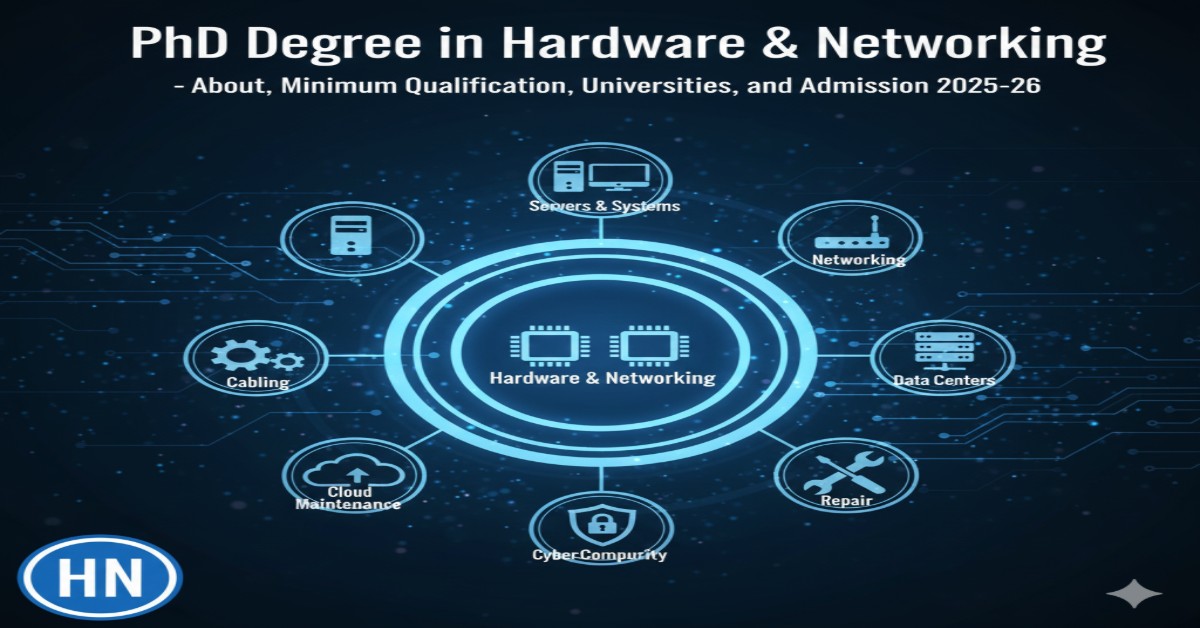
PhD Degree in Hardware & Networking - About, Minimum Qualification, Universities, and Admission 2025-26
About This Course
The PhD in Hardware and Networking is a highly specialized and research-oriented program designed for scholars passionate about advanced computing infrastructure, network architecture, embedded systems, cybersecurity, and next-generation communication technologies. This doctoral program aims to develop innovators and high-end researchers who contribute to the growing global demand for secure, efficient, and scalable digital ecosystems. It provides a strong foundation in theoretical and applied networking, computer hardware design, data communication, cloud computing, IoT infrastructure, wireless systems, and network automation.
Throughout the program, scholars are encouraged to pursue in-depth research in areas such as network protocol engineering, big data networking, next-generation switches and routers, high-performance computing systems, information security and encryption, Artificial Intelligence in networks, virtualization, and distributed computing. The curriculum includes advanced coursework, research methodology, laboratory experimentation, industry collaborations, field studies, and a dissertation.
Students receive academic guidance from distinguished faculty and also gain access to state-of-the-art networking labs, cloud simulators, cyber range tools, and hardware testing environments. The program emphasizes the development of critical thinking, analytical skills, and progressive research capability by encouraging scholars to work on real-world challenges in sectors such as telecommunications, cyber defense, banking technology, grid computing, smart devices, and digital infrastructure.
The PhD in Hardware and Networking is tailored for individuals who seek to drive innovation in computer architecture and modern network infrastructure. Graduates often become industry leaders, technology scientists, senior consultants, and academic researchers shaping the future of global communication and computing systems. This program not only builds technical expertise but also fosters the ability to create scalable and secure networks that meet industry and societal needs.
Eligibility
1. Eligibility Criteria for Admission
1.1 Educational Qualifications
To be eligible for a PhD in Hardware and Networking, candidates must possess a postgraduate degree in any of the following disciplines from a recognized university:
Computer Science
Information Technology
Electronics / Electronics & Communication Engineering
Computer Engineering
Network Engineering or related disciplines
A minimum of 55% aggregate marks is generally required in the qualifying degree. However, candidates belonging to reserved categories are granted a relaxation of 5%, subject to government and institutional norms.
1.2 Recognized Degree Equivalents
Candidates holding any of the following degrees are also considered eligible:
M.Tech / M.E. in relevant specialization
M.Sc. in CS/IT
MCA
M.Phil. in Computer Science / Networking Domain
1.3 Preferred Experience & Technical Expertise
While not mandatory, candidates with industry or academic experience gain advantage in selection. Valuable experience areas include:
IT infrastructure support
Network administration and security
Hardware troubleshooting and system maintenance
Data center operations and server management
Cybersecurity analysis and threat handling
1.4 Professional Certifications (Added Advantage)
Industry-recognized certifications strengthen the selection chances and research suitability:
CCNA, CCNP, CCIE (Cisco Certification Tracks)
CEH (Certified Ethical Hacker)
RHCE (Red Hat Certified Engineer)
CompTIA Network+ / Security+
These certifications highlight technical proficiency and practical exposure to real-time networking environments.
1.5 Research Readiness
Applicants must demonstrate research potential through:
Statement of Purpose (SOP) outlining interest and motivation
Preliminary Research Proposal related to networking or hardware components
Evidence of published papers, technical reports, industrial projects (if any)
Knowledge of programming basics, simulation tools, and security frameworks is beneficial, though not compulsory.
2. Admission Process
2.1 Application Submission
The application process typically begins with online/offline registration through the university portal. Candidates must submit:
Academic transcripts & degree certificates
ID proof and photographs
Experience certificates (optional but beneficial)
Entrance test scorecards (if applicable)
Initial research proposal
2.2 Entrance Examination
Most universities conduct a PhD entrance examination to assess technical and research capabilities. The test generally covers:
Computer Networks & Switching Concepts
Digital Electronics & Hardware Design
Operating Systems & Device Architecture
Cybersecurity Principles
Research Aptitude & Analytical Reasoning
Programming Fundamentals
Candidates who have qualified GATE, UGC-NET, CSIR-NET, SET, or hold an M.Phil degree may receive an exemption from the entrance test, as per university regulations.
2.3 Interview & Research Presentation
Shortlisted applicants must appear for:
Technical Interview, and/or
Research Proposal Presentation
During this stage, the selection committee evaluates:
Clarity of research objectives
Understanding of networking concepts
Academic competence
Motivation toward research and long-term goals
Feasibility and relevance of research problem
Successful candidates are allotted a guide/supervisor based on research interest alignment.
3. Post-Admission Process
3.1 Coursework & Research Training
Once enrolled, scholars need to complete compulsory coursework which may include:
Coursework evaluations involve assignments, seminars, and internal assessments.
3.2 Research & Thesis Development
After coursework completion:
Students register their research topic
Conduct experiments, simulations, surveys, or industrial case studies
Publish research papers in national/international journals
Present work at conferences & symposiums
The final stage involves preparing and submitting a PhD thesis, followed by a viva-voce/defense before an expert panel.
A PhD in Hardware and Networking opens pathways to high-level careers in network architecture, security research, hardware innovation, cyber-defense, academic teaching, and IT system consulting. Candidates with strong analytical skills, hands-on technology experience, and a passion for research will find this program a rewarding step toward professional excellence and academic contribution.
Future Scope
Top Career Opportunities After a PhD in Hardware & Networking
1. Network Architect
Designs and develops large-scale network infrastructures including LAN, WAN, cloud networks, and data centers. Responsible for network planning, performance optimization, and future scalability.
2. Hardware Design Engineer
Works on designing, testing, and improving computer hardware components such as processors, routers, chipsets, and embedded systems. Employment found in R&D labs, semiconductor companies, and tech manufacturing.
3. Cybersecurity Researcher
Focuses on network vulnerabilities, intrusion detection, cryptography, malware analysis, and secure architecture-building. Frequently hired by defense organizations, security labs, and cybersecurity firms.
4. Network Security Analyst
Monitors network traffic, detects threats, configures firewalls, and maintains high-level security protocols. Plays a key role in cyber-attack prevention and incident response teams.
5. Data Center Engineer
Manages server systems, cloud storage, backup infrastructure, virtualization platforms, and network monitoring. Ensures 24x7 data center operations with high reliability and uptime.
6. System Administrator (High-Level)
Maintains enterprise servers, network configurations, OS deployments, security policies, and cloud integration. Handles troubleshooting and performance optimization for critical IT environments.
7. Research Scientist – Networking
Works in universities, labs, or government research bodies to innovate new networking protocols, wireless communication models, IoT systems, and next-gen hardware technologies.
8. Cloud Infrastructure Specialist
Designs and manages hybrid/cloud network architecture using AWS, Azure, Google Cloud etc. A key role in virtual networking, SaaS deployments, and distributed computing environments.
9. IoT Systems Engineer
Develops interconnected smart devices and networks for automation, home tech, health devices, smart cities, and industrial IoT. Strong demand in automation, robotics & manufacturing sectors.
10. Wireless Communication Engineer
Specializes in RF systems, 5G/6G networks, Wi-Fi, satellite communication, and mobile network optimization. Works in telecom companies, aerospace, and communication R&D.
11. Technical Consultant / IT Infrastructure Advisor
Provides expert guidance to corporations on network planning, security frameworks, hardware upgrades, virtualization, digital transformation & cloud migration.
12. University Professor / Academic Lecturer
Teaches advanced networking and hardware subjects to UG/PG students, supervises research scholars, publishes papers, and participates in academic development & curriculum design.
13. Network Automation Engineer
Automates network tasks using Python, Ansible, SDN tools, and DevOps environments. Helps organizations shift to intelligent, self-managed networking systems.
14. Semiconductor Research Engineer
Works on chip manufacturing, circuit design, microprocessor improvement, and VLSI systems. High-salary roles in Intel, AMD, NVIDIA, Qualcomm, Samsung, etc.
15. IT Security Auditor
Conducts network audits, evaluates system compliance, identifies security loopholes, and ensures industry standards like ISO, GDPR, PCI-DSS & HIPAA. Often hired by banks, MNCs, and cybersecurity agencies.
No universities found offering this course yet.
Apply for PhD Degree in Hardware & Networking - About, Minimum Qualification, Universities, and Admission 2025-26 at